
What We Learned from a Week in Portugal
The Portugal C&I solar market is entering a remarkably stable phase, shaped by a decade of consistent regulations and steadily improving economics. Unlike many international solar markets that evolve through rapid policy swings or subsidy-driven cycles, Portugal has followed a predictable path of distributed generation supported by UPAC and UPP frameworks. Over the past week, our meetings with solar developers, EPCs, and investors revealed a market operating with confidence, clarity, and strong long-term fundamentals. With fast payback periods, rising investor interest, and new models like solar communities gaining traction, Portugal is quietly becoming one of Europe’s most reliable environments for solar growth.
A Mature and Stable Solar Market
Portugal’s regulatory foundation for distributed generation — particularly the UPAC and UPP regimes — has been in place for more than ten years. This long-term consistency is rare, and energy policies often fluctuate with political cycles. In Portugal, the framework has remained steady across different governments, giving companies the confidence to invest without fear of sudden regulatory shifts. As a result, the solar market has grown slowly but predictably, avoiding boom-and-bust periods. This stability has turned Portugal C&I solar market into a reference case for how clear rules can support continuous C&I solar adoption without relying on subsidies.
Government Subsidies Are Creating Distortions
Despite strong project economics, recent government and EU incentives — including PRR funding — are entering a sector that does not fundamentally need subsidies. Instead of accelerating growth, these programs often create delays as clients wait for approvals and paperwork. Solar developers report that many companies postpone investment decisions in hopes of benefiting from these funds, even when the subsidy value does not justify the lost time. This dynamic distorts the natural market flow and introduces bureaucratic friction in an ecosystem that historically grew efficiently without such interventions.
Economics: Three-Year Paybacks Are Now the Norm
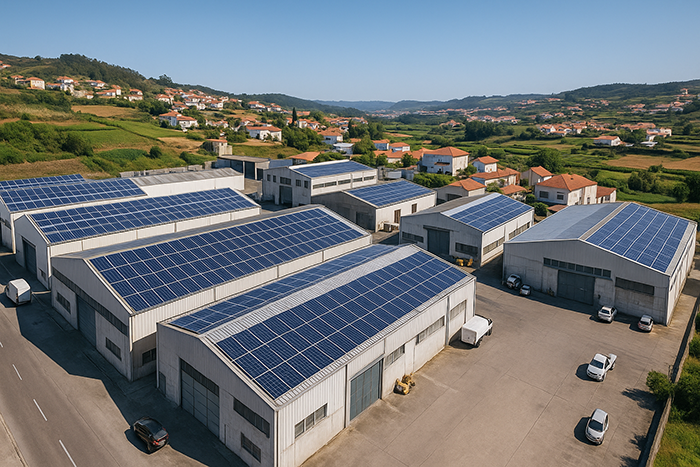
One of the most striking characteristics of Portugal’s C&I solar market is the consistently short payback period, often around three years. For an asset with a lifespan of 20 to 25 years, this represents an exceptional return profile. It also explains why the sector has matured without requiring subsidies or feed-in incentives. The financial case for rooftop solar is strong enough to drive decisions based purely on economics. This stability reinforces Portugal’s position as one of Europe’s most attractive and predictable solar environments, where long-term project performance is easier to forecast.
EPC Contracts Dominate a Mid-Size Market
In contrast to many international markets where PPAs are becoming the standard model, Portugal remains predominantly EPC-driven. Solar developers estimate that roughly 80% of C&I rooftop projects with mid-size companies are built under EPC contracts, with companies choosing to self-invest rather than sign long-term power purchase agreements. The reason is straightforward: with paybacks of around three years, businesses prefer to own the asset and capture the full financial benefit. PPAs still exist, but mainly for larger or more complex clients. This EPC dominance is a defining feature of Portugal’s distributed generation landscape and one that differentiates it from neighbouring European markets.
Investment Funds Are Increasing Their Presence
European infrastructure funds and pension investors are paying increasing attention to Portugal’s distributed generation segment. Several investors have already begun acquiring local companies or assembling portfolios of operating assets. What attracts them is not rapid growth, but the combination of regulatory stability, predictable returns, and improving macroeconomic conditions. Portugal’s financial environment has strengthened significantly compared to a decade ago, making it a more appealing destination for long-term capital. As distributed generation scales, investment funds are positioning themselves to play a larger role in owning and managing solar assets across the country.
Solar Communities Are Emerging as the Next Step
With UPAC and UPP frameworks well established, solar developers are now turning their attention to solar communities and local energy sharing. These models allow excess rooftop generation to be consumed by nearby homes or businesses, creating more efficient use of distributed assets. Storage integration is also becoming more relevant, enabling systems to shift production into evening hours. Portugal’s liberalized energy market makes it one of the most promising countries in Europe for testing and scaling these concepts. What was once a behind-the-meter market is gradually evolving into a more interconnected and flexible distributed generation ecosystem.
A Path Toward 500+ MW/Year of Distributed Generation
Although Portugal is a relatively small country, its solar market is expected to add more than 500 MW of distributed generation annually over the coming years. This growth will not come from sudden policy shocks or large incentive programs, but from the steady alignment of strong economics, regulatory clarity, and investor interest. Solar developers described a market where opportunities continue to expand at a healthy, sustainable pace. Combined with new models like solar communities and storage, Portugal’s trajectory points toward a robust and consistent expansion of its C&I solar capacity.
Portugal’s solar market stands out for its stability, clarity, and balanced growth. While many countries experience rapid shifts driven by subsidies or regulatory resets, Portugal has built a decade-long foundation that supports long-term planning and confident investment. The combination of fast paybacks, strong adoption of EPC models, increasing investor participation, and emerging solar community projects creates a compelling environment for distributed generation. As the country continues to expand its C&I solar footprint, these fundamentals will likely remain central to its progress, shaping a market defined by predictability rather than volatility.